AI Search Optimization and Citation Strategy for the LLM era
Get your business found, accurately summarized, and quoted inside ChatGPT, Perplexity, Google AI Overviews, and Claude. Clearer pages, better structured data, and the small set of files AI crawlers now look for.
Overview
AI tools have changed how a real share of buyers find businesses. A prospect asking ChatGPT "best HIPAA-aware web developer in the U.S." or Perplexity "what is llms.txt and who does it well" is doing the discovery work that used to start with a Google search. Whether your business gets mentioned, and whether it gets described accurately, depends on what AI tools see when they read your site.
Most sites are not built for this yet. Marketing pages are written for human skim-readers. AI tools read them differently. Definitions are buried inside paragraphs instead of on their own line. Service descriptions are vague and emotive instead of concrete and entity-clear. FAQ sections answer keyword questions instead of the questions buyers actually ask. Schema markup is missing or partial.
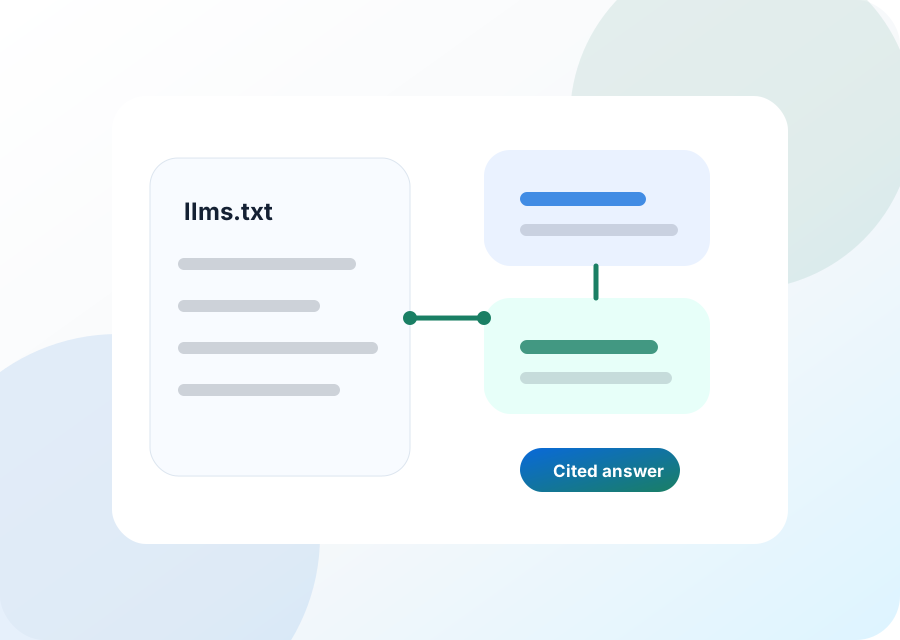
Our AI Search Optimization service fixes that. It builds on top of strong SEO, then adds specific work: definition blocks AI tools can quote verbatim, comparison tables, entity-clear language, fuller JSON-LD, and a hand-authored llms.txt. The goal is to be the source AI tools reach for when answering questions about what you do.
What is AI Search Optimization?
AI Search Optimization (also called Generative Engine Optimization, or GEO) is the work of designing web content and structured data so AI answer engines can find it, understand it, summarize it, and cite it accurately. It grew out of traditional SEO once tools like ChatGPT, Perplexity, Google AI Overviews, Claude, and Microsoft Copilot started answering user questions directly instead of returning a list of links.
In practice it means writing pages with clear definitions, scannable answer blocks, structured comparisons, named entities, accurate schema markup, and discovery files like llms.txt. The work sits at the intersection of content marketing, technical SEO, and structured data.
Focused service pages
AI Search Optimization breaks into four focused engagements. Most clients need a mix. We recommend the right starting point during scoping.
How we approach it
- Citation baselineWe run a curated set of prompts, usually 50 to 200 depending on the engagement, through ChatGPT, Perplexity, Claude, and Google AI Overviews. We record where you are mentioned, where competitors are mentioned, and where the tools hallucinate or misrepresent your services.
- Page-level auditFor each high-priority page we check definition clarity, FAQ quality, schema completeness, entity language, comparison and structured-data opportunities, and internal-link reinforcement.
- Structural improvementsDefinition blocks, FAQ sections, statistics with sources, comparison tables, and schema upgrades. Each is documented as both a content change and a new surface AI tools can extract from.
- Discovery-layer workA hand-authored llms.txt, an AI-friendly sitemap structure, a robots.txt that explicitly allows the major AI crawlers, and clean canonicalization. The infrastructure that decides what AI tools see when they look at your site.
- Citation re-testWe re-run the prompt set 30 and 60 days after changes ship. We compare citation rate, citation accuracy, and competitor share. Then we do a quarterly review of what to adjust next.
SEO vs AI Search Optimization at a glance
Same foundation, different additions. AI Search Optimization sits on top of strong SEO. It does not replace it.
| Concern | Traditional SEO | AI Search Optimization |
|---|---|---|
| Primary surface | Google search results pages (10 blue links) | ChatGPT, Perplexity, Claude, Google AI Overviews |
| Optimization unit | Page ranking for a target query | Citation share for a topic, with an accurate summary |
| Content shape | H-tag hierarchy, keyword targeting, internal links | Definition blocks, FAQ patterns, entity-clear language |
| Structured data | Organization plus a few key page-type schemas | A fuller @graph with speakable and Person/author |
| Discovery files | robots.txt and sitemap.xml | robots.txt, sitemap.xml, and a hand-authored llms.txt |
| Measurement | Rankings, organic clicks, GSC impressions | Prompt-based citation tests and AI Overview impressions |
What this service includes
- A curated AI-tool prompt set with citation baseline
- Page-by-page AI-readiness audit
- Definition blocks and FAQ rewrites
- A fuller JSON-LD graph across all page types
- Hand-authored llms.txt
- AI-crawler robots.txt and sitemap configuration
- Entity-language consistency across pages
- Comparison tables and statistics blocks
- 30 and 60-day citation re-tests
- A quarterly written report on citation share
Engagement example
A specialty B2B services firm was effectively invisible to AI tools. 0 of 80 baseline prompts cited their site, and the ones that did mention them by name described the services incorrectly. We rebuilt the service-page surface with definition blocks, FAQ sections, and proper schema. We hand-authored an llms.txt. We fixed the entity-language inconsistencies that had been confusing the AI tools.
Representative engagement. Client identity withheld for privacy.
Frequently asked questions
Want to know how AI tools see your business right now?
Send us your URL. We'll run a 20-prompt baseline through ChatGPT, Perplexity, and Claude and write back with what we found.